6 municipalities contributed data for 40 locations in 2024 to the Partnership.
2024
Executive Summary
The Keep It Clean Partnership (KICP) is made up of six partner communities: the cities of Boulder, Longmont, Louisville, and Lafayette, the town of Superior, and Boulder County. KICP staff collaborate with these communities and other organizations with the goal of improving watershed health.

One way that KICP fosters watershed health is by assembling data collected by local municipalities to evaluate annual and long-term trends throughout the Boulder St. Vrain watershed. This report focuses on data collected in 2024 as described in the KICP coordinate monitoring plan and how it compares to past periods.
Read more about the KICP collaborative monitoring program.
See previous reports including the PDF 2019 Water Quality Report and the online 2023 report.
To access other past reports, please contact Cristina Ramirez at [email protected].
Monitoring Locations Map
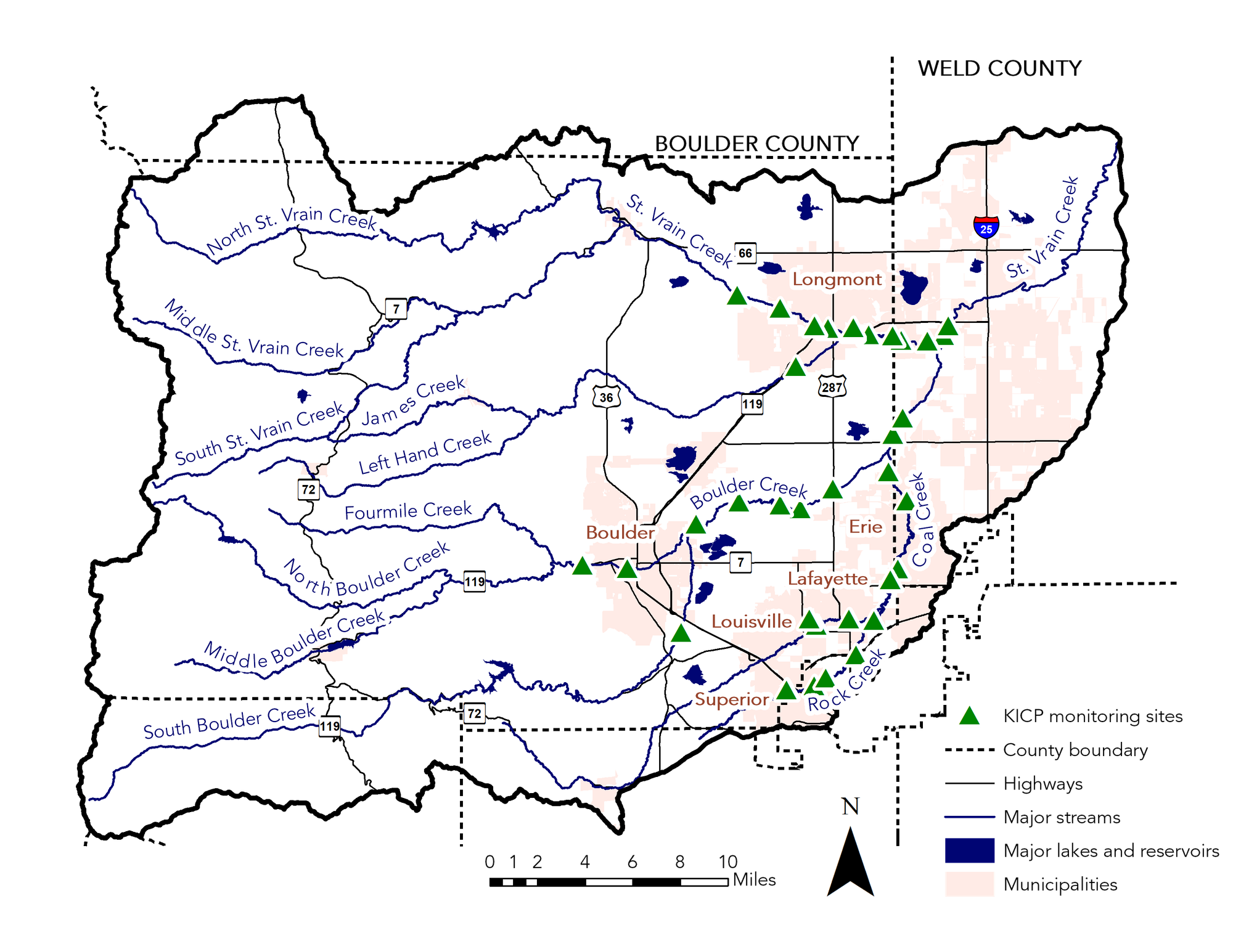
The map below shows the extent of the Boulder St. Vrain watershed monitored by KICP Partners and the location of routine monitoring sites. To explore this information more actively, visit the interactive monitoring locations map where you can find out more information on each monitoring site, view data collected for each site, and explore nearby streamflow monitoring stations.
Data Collection Highlights
The KICP created this online water quality report to make the collected water quality data more accessible and easier to understand. Highlights and key findings from analysis of the data include:
Over 5,000 water quality observations were analyzed for 60 water quality parameters.
Nutrient concentrations are higher downstream of wastewater treatment facilities.
Most pollutant concentrations remained stable or decreased throughout the watershed from 2019 through 2024.
Impacts of non-point sources throughout the basin are not well understood and are worth further investigation. Partners should continue existing monitoring efforts and address pollution through compliance with their respective municipal stormwater (MS4) and wastewater (NPDES) permits. As opportunities arise to do so, partners may consider expanding monitoring efforts to better understand and reduce non-point source pollution.
Precipitation and Streamflow
In 2024, the watershed experienced nearly double the historical average precipitation in the months of May and June.More about Precipitation
Streamflow reflected the high rainfall in May and June but was near historical averages the rest of the year.More about Streamflow
General Water Quality
Key influences on water quality include high flows due to spring rain, snowmelt runoff and storm events. High flow conditions tend to dilute certain parameters, including hardness, alkalinity and conductivity, which are all fairly elevated in this watershed due to natural geologic conditions. High flow events can also transport sediment, stir up stream beds and erode stream banks, leading to increased suspended solids.
pH and Dissolved Oxygen Periodic exceedances of the pH standard can occur, typically occurring when DO concentrations are high. Treated effluent has minimal influence on pH and DO conditions.View Dissolved Oxygen Boxplots
Hardness is strongly influenced by the soft water of spring snow runoff, which lowers hardness (as well as alkalinity and conductivity) in April, May and June.View Hardness Graphs
Sulfate is monitored primarily in the St. Vrain. Levels are reduced during spring runoff, but they do rise steadily from upstream-to-downstream. Factors influencing this trend are not known but likely related to natural hydrogeology.View Sulfate Graphs
Total Suspended Solids are generally low throughout all the streams. Higher levels in 2024 can be explained by seasonal runoff and increased flow conditions due to elevated precipitation which temporarily stirs up solids from the stream bottom.View TSS Graphs
Alkalinity and Conductivity values are highest in upper Coal Creek but still at healthy levels, likely influenced by natural geology. These constituents tend to increase upstream-to-downstream, however Louisville treated effluent tends to lower Conductivity in Coal Creek by over 40%.View Conductivity Graphs
Dissolved Organic Carbon serves as a primary food source for aquatic microorganisms, and high concentrations can indicate organic pollution. DOC levels in Boulder and St Vrain creeks are healthy in all reaches. DOC is not monitored in Coal Creek.View DOC Graphs
Read more about General Water Quality
Nutrients
Nutrient values are generally lower during periods of high streamflow and higher during periods of low streamflow. This can be seen clearly in the 2024 data, with nutrients trending lowest in May when runoff was at its peak from snowmelt and highest during low flow months.
Effluent from wastewater treatment facilities can have a significant impact on nutrient levels, especially when facilities are treating a large amount of water. Additional nutrient standards are anticipated for streams in this watershed in the next decade, and current conditions may not meet proposed standards. As such, wastewater treatment facilities will likely be required to update or improve treatment processes to further reduce the amount of nutrients discharged to streams. Some wastewater treatment facilities in the watershed have invested significantly in reducing nutrients in treated effluent. We can see positive impacts from these investments in both St. Vrain and Boulder Creeks. Mitigating or preventing inflow of nutrients to the watershed will continue to be a major focus in future years.
Nitrogen and Phosphorus increase upstream-to-downstream throughout the watershed, influenced predominantly by treated effluent discharge. Effluent concentrations have been stable or slightly reduced in the past decade. Nutrient reductions are a focus for the basin, including exploring strategies to address negative impacts of wastewater effluent discharge.View Nitrogen and Phosphorus Graphs
Ammonia concentrations have been stable or slightly reduced over the past decade across most locations. A pattern of reduced Ammonia concentrations over time is most notable below the Longmont wastewater treatment facility discharge point on the Saint Vrain Creek, where levels have been gradually declining since 2020.View Ammonia Graphs
E. coli
Escherichia coli (E. coli) is a type of bacteria found naturally in the environment and in the digestive tracts of animals and humans. E. coli is often harmless, but persistently high levels can indicate an increased risk of illness when recreating in a waterbody. KICP carefully monitors E. coli in the watershed.
E. coli exceedances are a common problem across the Front Range, Colorado, and the United States. All streams monitored by KICP periodically exceed levels that the U.S. Environmental Protection Agency deems safe for recreational use. Typical sources of E. coli in urban streams include wildlife, pets, trash, and human influence.
Recreate safely: Exposure to E. coli and other microorganisms is a risk when wading or swimming in any natural water body. Most types of E. coli do not cause illness, but there are strains that can cause gastrointestinal illness, and E. coli can be an indicator of other pathogens that can make people sick.View E. coli Graphs
Read more about Bacteria and E. coli
Metals
Metal concentrations are variable but at generally healthy levels throughout the KICP watershed. Metals commonly found in municipal effluents are predictably elevated downstream of treated wastewater effluent outfalls, but not to a harmful degree. Most metal concentrations also trend upward slightly from upstream to downstream, likely due to mineralization of the streambed.
Most Metal Concentrations show similar patterns across most locations, increasing with low flows and geographically from upstream-to-downstream. This suggests that metals in the watershed are predominantly influenced by underlying geology. Effluent discharge does not tend to affect levels of metals in the streams and all metals are well within safe levels throughout the basin.
Arsenic tends to increase upstream-to-downstream like other metals but has also been steadily decreasing across most Boulder Creek sites over the past decade. Reasons for this observed decreased are being investigated.View Arsenic Graphs